

.svg)
VSME Reporting: From Awareness to Action – What’s Still Missing?

The Promise of VSME
VSME was never just a reporting tool. For banks, it’s a way to assess credit risk. For large companies, it supports value-chain transparency. For building owners, it creates the basis for green valuations and financing. It’s voluntary, but increasingly essential.
The recent VSME Market Acceptance Survey, conducted by EFRAG, shows that awareness is rising and early adopters report real benefits — better access to finance, more strategic clarity, and improved cost efficiency. Yet the same survey paints a picture of slow uptake and persistent hurdles.
The Problem: Fragmentation, Friction, and Fatigue
Three barriers dominate:
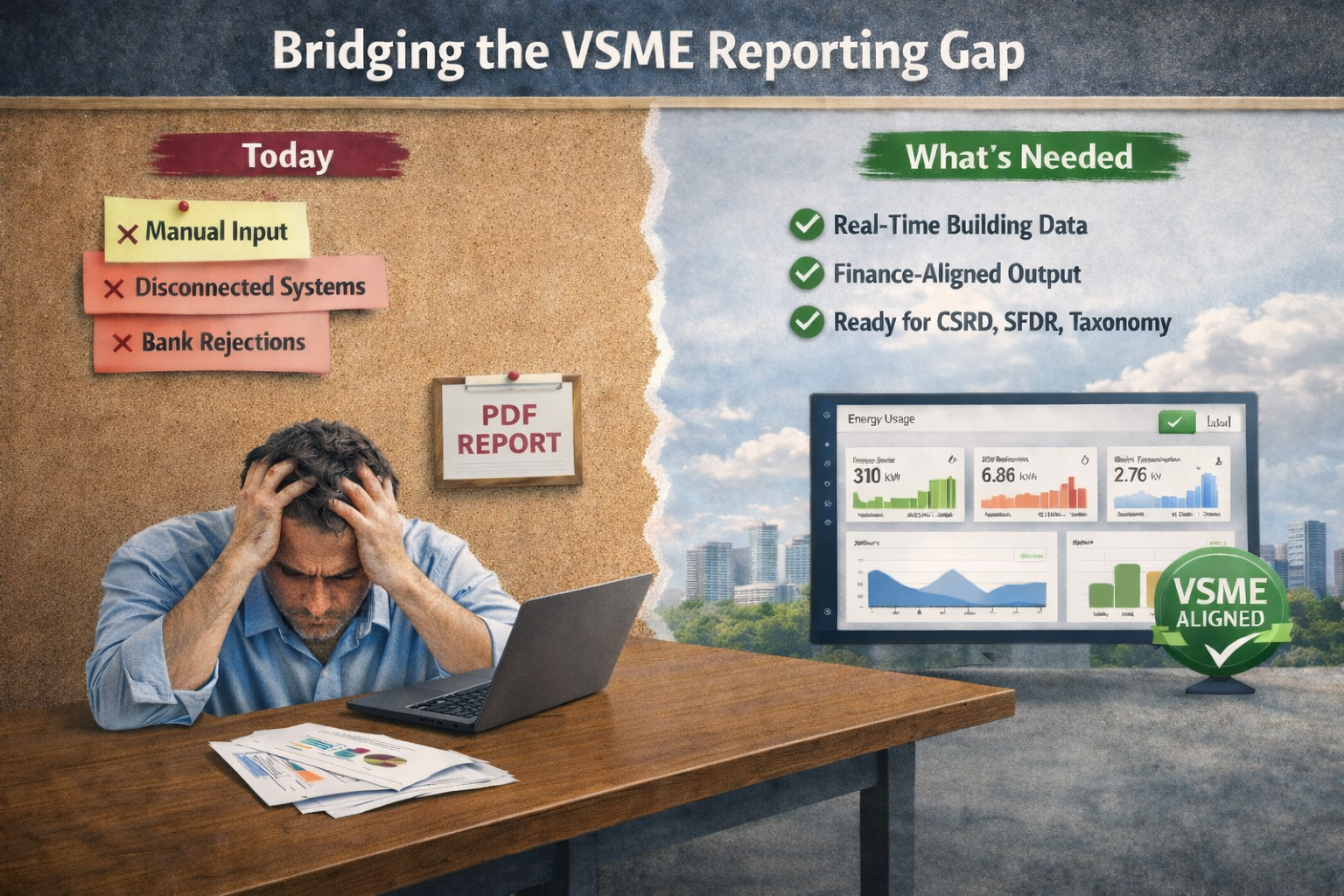
- Lack of practical tools: Most SMEs don’t have access to simple, free, and sector-specific solutions. Many still rely on manual processes or templates not aligned with VSME disclosures.
- Poor data usability: There's no centralised digital infrastructure for collecting, storing, or reusing VSME-related data. SMEs can’t easily repurpose data for different users — lenders, tenants, regulators.
- Unclear alignment with what banks want: Financial institutions often request data that go beyond VSME scope — such as Scope 3 emissions, due diligence, or taxonomy alignment.
Without a better system, VSME risks becoming another compliance burden instead of the catalyst for ESG performance it was meant to be.
What Needs to Change?
To move from pilot adoption to market-wide utility, VSME needs a layer of infrastructure:
- Digital-first reporting – not just templates, but integrated platforms that capture real-time energy, emissions, and usage data from buildings and operations.
- Interoperability with banking and regulatory needs – structured outputs that align with SFDR, EU Taxonomy, and CSRD disclosures. Especially important for buildings, which are a major source of emissions and financing exposure.
- Guided workflows – so SMEs, building managers, and tenants can contribute data without being ESG experts. Think of step-by-step digital journeys, not static PDFs.
- Certification and trust – mechanisms to validate and standardise VSME reports, particularly for financial due diligence.
The Opportunity for Buildings and Banks
Commercial real estate is at the center of this transformation. Buildings are responsible for 40% of EU energy use, and banks are already integrating sustainability risks into underwriting and loan valuation. For building owners, that means access to capital is increasingly tied to real, verifiable ESG performance — not estimates.
SME landlords that can generate trustworthy VSME-style reports tied to energy and emissions performance will be better positioned for refinancing, taxonomies, and even tenant retention.
For banks, it means having access to a standardized data layer that can be plugged directly into portfolio-level risk tools — turning sustainability reporting from a bottleneck into an enabler.
Conclusion
The VSME framework has laid the groundwork. What’s needed now is to make it usable — embedded in real systems, mapped to financial and regulatory expectations, and easy to act on.
That’s where the next wave of innovation lies — not in more reporting standards, but in tools that turn ESG reporting into ESG performance.
If your organisation is struggling to turn VSME intentions into practical, bank-ready reporting, this is exactly the gap Bember addresses. Bember 360 Compliance is a digital infrastructure product designed to operationalise VSME-style reporting for buildings and portfolios — linking real energy and emissions data to the formats banks and regulators actually use. It reduces manual effort, improves data credibility, and makes ESG reporting actionable rather than theoretical. If you want to move from awareness to execution, contact Bember to discuss how Bember 360 Compliance can support your VSME journey.